
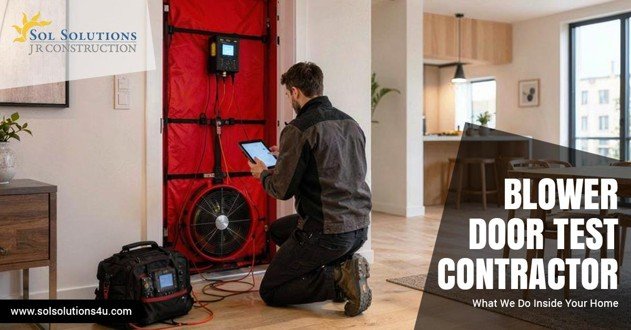

Homeowners often ask us why their rooms never stay comfortable. We start with one tool. A calibrated fan and a gauge tell us more than an hour of guessing. This page explains what we do, what the numbers mean, and how you can prepare.
What happens when a blower door test contractor arrives?
We walk your home first. We note the size, the heating system, and any open flues. Then we close windows, exterior doors, and fireplace dampers. We switch off exhaust fans and set the thermostat so the system stays idle. We seal an adjustable frame into one exterior doorway. A calibrated fan mounts in that frame.
The fan pulls air out of the house. Pressure inside drops to negative 50 Pascals (like a 10-mile wind) relative to outside. Outside air rushes in through every gap. We record the airflow at that pressure. Then we trace the leaks with a smoke pencil or an infrared camera.
Our crew also checks gas appliances before and after the test. Depressurizing a house can pull exhaust back down a flue. We confirm that your water heater and furnace still vent safely. This step protects your family and keeps the test honest.
When you hire a blower door test contractor, expect clear access to every room. You can stay home. We work around you.
Why should you book a blower door test near me in Napa?
Local conditions raise the stakes. Wine country has seen wildfire smoke, cool nights, and dry summers. A leaky house pulls smoke and dust through outlets, attic hatches, and recessed lights. It also loses conditioned air through the same gaps.
We find the same trouble spots again and again. Attic hatches rarely seal. Recessed lights open straight into the attic. Plumbing and wiring holes leave gaps in walls and floors. Fireplace dampers let air pass even when closed. Each leak adds up.
A search for blower door test near me should reach a team that knows local homes. We serve Napa and nearby S. F. Bay Area communities. We know older ranch homes and newer infill builds. We know the leaks each one hides.
Weather also matters. Strong wind can skew a reading, so we pick our timing with care. We note outdoor conditions in every report. That habit keeps results fair and repeatable.
What do CFM50 and ACH50 actually tell you?
CFM50 is the airflow the fan moves at 50 Pascals. ACH50 converts that airflow into air changes per hour. The formula is simple: CFM50 × 60 ÷ the house volume in cubic feet.
Here is an example. A home has 1,800 square feet and 8-foot ceilings. That gives 14,400 cubic feet. The fan reads 1,800 CFM50. The math gives 7.5 ACH50. This is the average leakage or Air Changes per Hour of an average home.
A lower number means a tighter house. A tighter house loses less conditioned air. It also needs planned ventilation, because stale air has fewer ways to leave. The EPA says some indoor pollutants run 2 to 5 times higher than outdoor levels. Tight homes need fresh air by design.
We never read the number alone. We compare it with your comfort complaints and your utility habits. Then we rank repairs by impact. Big gaps in the attic floor come first. Small gaps around trim come last. Our crew retests after sealing, so you see the improvement in writing.
How does the test connect to ECC and CALGreen paperwork?
Some Energy Code compliance paths call for envelope testing. An ECC rater verifies the result. ECC stands for Energy Code Compliance. Ask your designer or builder which path your project follows.
CALGreen also asks for documentation. Section 703.1 lists inspection reports and installer certifications as accepted proof. Section 702.2 requires special inspectors to show competence in their field. Our team holds a CALGreen special inspector credential. We handle both the test and the paperwork.
Good paperwork saves time at final inspection. We organize your test results, photos, and notes in one file. Your builder, designer, or inspector can read them without a phone call. Homeowners keep a copy for the life of the house.
What is the Benefit? The test also guides the decision for smarter upgrades. A tight envelope lets your HVAC contractor choose a smaller system. Insulation performs better when air stops moving through it. Solar sizing improves when your energy load drops. Testing first protects every future dollar you spend.
Ready to find your leaks?
J R Construction Sol Solutions Inc. tests, seals, and verifies homes across Napa and nearby San Francisco Bay Area communities. We hold CSLB license 953923 and answer at 707.299.8850. Call us, and we will book your test and explain every number we read. Before we arrive, clear a path to your attic hatch and electrical panel. Tell us which rooms feel hot, cold, or dusty. Those clues speed up the search.
Frequently Asked Questions
- What is a blower door test?
It measures air leakage through your home envelope. We use a calibrated fan at 50 Pascals. The result shows how tight or leaky your house is.
- Will the test disrupt my day?
No. We need access to every room and one exterior door. You can stay home.
- Do I need a blower door test for ECC verification?
It depends on your compliance path. Your designer or ECC rater can confirm. We help you check.
- Can I fix the leaks myself?
You can fix small ones. Weatherstrip doors, seal attic hatches, and caulk trim. Larger gaps need a pro.fessional. We retest after any repair.
- Will sealing my home hurt my indoor air?
Not with planned ventilation. CALGreen suggests keeping indoor humidity between 30 and 60 percent. We check airflow after sealing.
Related Blog:-